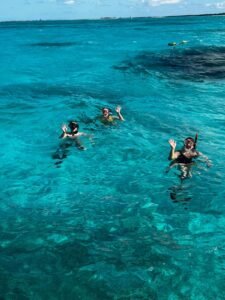
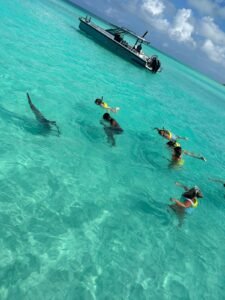
Queen conch is the national dish, the thing on every menu on the island, and — on a boat day — something you can go and find yourself on the sea floor.
Conch diving is listed on most of our charter itineraries. Here is what it actually involves, because the phrase makes it sound more technical than it is.
What conch diving is
It is free-diving in shallow water to pick a large sea snail up off the sand.
That is genuinely it. No tanks, no certification, no equipment beyond a mask and fins, which are included on every charter. Queen conch live on sandy and seagrass bottoms in water that is often only a few metres deep, and in clear Caicos water you can see them from the surface.
You take a breath, you go down, you pick one up, you come back. Children do it. People who have never dived do it. The hardest part for most first-timers is equalising their ears on the way down, and the crew will show you how.
How it works on a charter
The captain anchors somewhere he knows conch are likely to be — this is local knowledge and it is most of what makes the difference between seeing one and seeing none. Crew get in with you and point them out, because a conch half-buried in sand with algae on the shell does not look like anything until somebody shows you the first one.
It usually takes fifteen minutes before somebody in the group has their eye in and starts spotting them independently. That is the good part.
It is on the itinerary for:
- Half-day private boat charter — $1,450, 4 hours, up to 6 guests
- Full-day private boat charter — $2,500, 7 hours
- Luxury yacht charters, half and full day — from $2,500
All excluding 12% government tax. Whether it happens on your day depends on conditions and on where the route takes you, so mention it when you book if it matters to you.
Lobster, and why the answer is “sometimes”
Caribbean spiny lobster appears on our full-day menu with the word “seasonal” beside it, and that is not hedging — lobster here has a closed season, and outside it nobody is taking lobster legally.
If lobster matters to your trip, ask us whether it is in season for your dates before you book. We will tell you straight. Shell hunting and conch diving run year round.
The shell rule that catches people out
This is the practical bit, so read it even if you skip the rest.
Queen conch is an internationally protected species, and taking shells out of the country is restricted. It is not a case of popping one in your suitcase. There are rules about numbers, about whether the shell has been processed, and about permits, and customs at the other end have their own view as well.
Every season, visitors have conch shells confiscated at an airport because nobody told them. We would rather be the ones who told you.
If you want to take a shell home, ask us before the day and we will tell you where things stand and what is actually possible. Do not assume, and do not take advice from somebody selling shells on a beach.
Eating what you find
Be realistic about this. Conch takes real work to get out of the shell and then real work to tenderise — it is not a thing that happens casually on a deck between swim stops.
On the full-day charters, a private chef prepares a Caribbean meal on board: jerk chicken, steak and shrimp kabobs, grilled snapper, BBQ ribs, lobster in season, peas and rice, mac and cheese, plantains, salad, bruschetta and fruit. If you want what you have found to be part of the day, raise it when you book rather than on the boat, and we will tell you honestly what is possible on your trip.
On a half day, treat conch diving as the activity rather than the shopping.
Looking after the thing you came to see
Conch populations across the Caribbean are under pressure, and Turks and Caicos manages its fishery deliberately. A few things that cost you nothing:
- Leave undersized and immature conch where they are. The crew will tell you which is which.
- Put back anything you are not taking, the right way up, where you found it.
- Do not stand on coral to get a better look at something on sand.
- Reef-safe sunscreen, applied before you leave rather than in the water.
Common questions
Do I need to be able to dive?
No. If you can swim down a couple of metres and come back up, you can do this. Crew are in the water with you.
Can children do it?
Older children usually love it. Child-sized masks and fins are on board. Younger ones are often happier spotting from the surface with a life jacket on while an adult dives.
Is it safe?
Shallow water, crew present, nothing you have to hold your breath for long. Shuffle rather than stamp on the bottom, and wear fins.
Will we definitely find conch?
Usually, but it is wild animals on a sea floor and no captain can promise it. Conditions and visibility matter.
Can I keep a shell?
Ask us first. Export is restricted and the rules are not optional. See above.
Which charter is best for this?
The full day gives the most time and reaches the quieter ground. Tell us it is a priority and the route will reflect it.