Somebody in most groups is worried about this, and they are often the person who has not said so yet.
The useful facts: the water around Providenciales is protected by the third-largest barrier reef in the world and the shallow Caicos Banks, which is why it is calmer here than in a lot of the Caribbean. Most of our guests, most days, feel nothing at all. But “usually calm” is not “always calm”, and if you know you are prone, plan for it rather than hope.
What actually causes it on a trip like this
Two different things, and they have different answers.
Movement underway. Running into chop. Short, repetitive motion. This is worse on a windy day and worse on a small single-hull boat.
Rolling at anchor. This is the one that catches people out. Sitting still at a snorkel stop with swell coming through, with your eyes on something close by, is more provocative than the ride out. A lot of people who are fine while moving start feeling it during the second swim stop.
Which boat is steadiest
| Boat | Steadiness | Why |
|---|---|---|
| Catamaran with slide | Best | Two hulls roll far less, underway and at anchor |
| 65ft Fairline Targa GT | Very good | Weight and length cut through chop |
| Luxury yacht | Good | Larger hull, plus an air-conditioned interior to sit in |
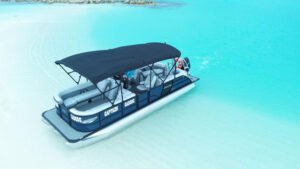
| Private boat | Fine on calm days | Smaller and more responsive to swell |
If one person in your group is genuinely prone, the catamaran is the booking. It is also the one with the most deck space to move around on, which helps.
What to do before the day
- Take medication before you board, not after you feel it. This is the single most common mistake. Most over-the-counter remedies need to be in your system beforehand and do very little once symptoms start. Follow the packet, and check with a pharmacist if you are unsure or on other medication.
- Eat something plain beforehand. An empty stomach is worse, not better. Toast is fine; a large greasy breakfast is not.
- Skip the heavy drinking the night before. Dehydration makes everything worse.
- Book the morning slot. Wind here commonly builds through the day, so mornings are often the calmer half.
What to do on the day
- Stay on deck, in the open air. Going below or into a cabin to lie down usually makes it worse.
- Look at the horizon, not at your phone, not at the deck, not at a book.
- Sit toward the middle of the boat, where there is least movement.
- Get in the water. This works remarkably well and almost nobody expects it. Floating in the sea is steady in a way the deck is not, and most people feel better within a few minutes.
- Keep sipping water, and go easy on the rum punch.
- Tell the crew early. They have seen it a thousand times, nobody will make a thing of it, and there is a lot they can do if they know at the start rather than the end.
The advantage a private charter has
This is the real point of the article.
On a group tour, if you feel unwell an hour in, you are on that boat for the remaining three hours and the itinerary does not care. There is nothing to be done except endure it, which is a miserable way to spend an afternoon in the Caribbean.
On a charter that belongs to you, you tell the captain and the plan changes. He moves into the lee of a cay where the water is flat. He drops the exposed reef stop and heads for a shallow sandbar where you can stand up. He cuts the day short and runs you in, and nobody else is inconvenienced because there is nobody else.
For a group containing one person who is anxious about boats, that flexibility is worth more than the price difference. It is also why we ask about it when you book.
Routes that suit a nervous passenger
Tell us, and the day gets built differently:
- Sheltered water only. The banks and the lee side of the cays, not the exposed outer sites.
- Sandbars rather than reef. Shallow water, standing depth, minimal swell.
- Shorter runs between stops. More time at anchor in calm spots, less time underway.
- The sunset cruise instead. Two hours along Grace Bay, inside the reef, in the calmest water of the day. $900 on the standard boat, $1,700 on the yacht, before 12% government tax. If someone is genuinely frightened of boats, this is the gentle introduction.
Common questions
How rough does it usually get?
Inside the reef and on the banks, generally not rough at all. The exposed sites and the longer crossings on a full day are where you feel it. See our guide to wind and what gets cancelled.
Is the catamaran really that much steadier?
Yes, noticeably. Two hulls make a real difference at anchor, which is where most people struggle.
What if someone is sick on board?
It happens, the crew deal with it calmly, and nobody will make you feel awkward. Tell them early.
Should we just not book a boat?
If somebody is severely affected, the sunset cruise or a sheltered half day is a far better bet than a seven-hour trip. Tell us honestly and we will tell you honestly.
Do children get seasick more?
Some do. The same rules apply: fresh air, horizon, get them in the water, and medication beforehand if you are using it — checked with a pharmacist for their age.
Can we decide the route on the day?
Yes. That is what a private charter is. Tell us who is coming and we will plan around them.